How to Build a Content Strategy That Actually Ranks in 2026
A content strategy framework that combines topical authority, search intent, and E-E-A-T to drive organic rankings. No fluff, just results.

AEO Strategy Lead & Co-Founder
Why Most Content Strategies Fail
The internet is flooded with noise right now. Millions of blog posts go live every single day. Yet most of them never generate a single visitor from organic search. The problem isn’t that content marketing has stopped working. It is that most businesses, especially here in Hawaii, approach content without a framework that connects individual posts to a real competitive advantage.
We have seen this pattern repeat itself since we started building digital products in 2012. A local business starts a blog, posts randomly for three months, and gives up when the phone doesn’t ring.
A content strategy that ranks in 2026 must do three things simultaneously. It needs to build topical authority that search engines recognize, match content to specific local intent, and demonstrate the E-E-A-T signals that modern algorithms demand. Pair this with a solid technical SEO foundation and you have a recipe for sustainable growth.
Let’s break down exactly how to accomplish each of these for your business.
The Pillar-Cluster Model: Your Authority Architecture
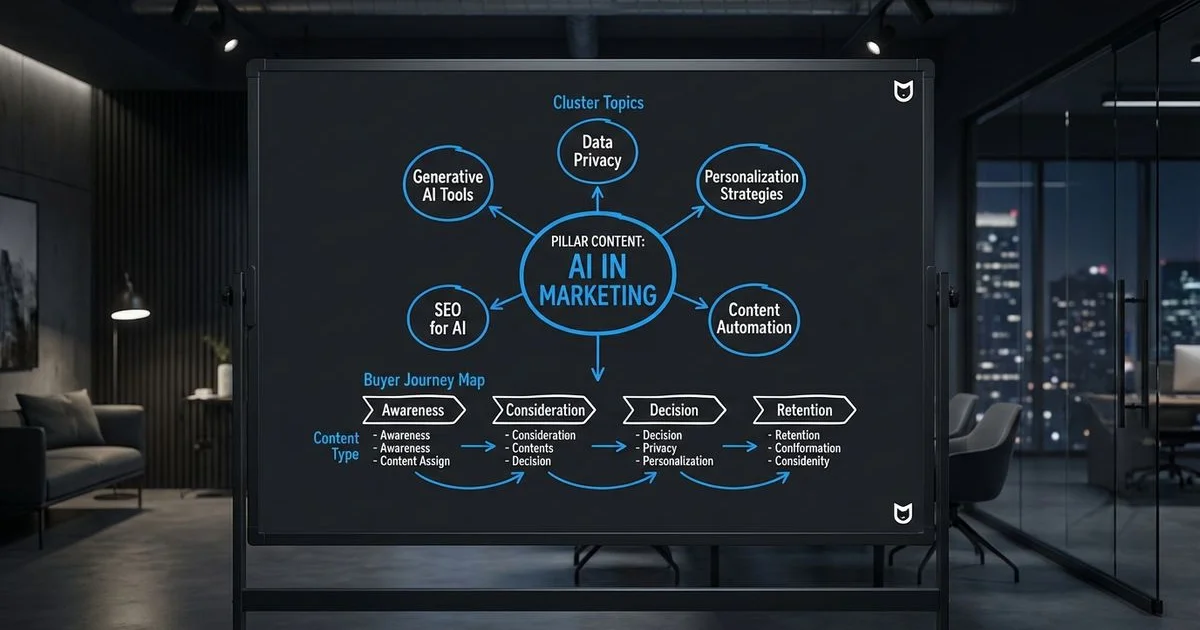
The pillar-cluster model is the most effective architecture for building topical authority. This method organizes your website into interconnected hubs that signal deep expertise to both traditional Google crawlers and new AI engines.
What Is a Pillar Page?
A pillar page is a comprehensive resource that covers a broad topic in depth. It typically ranges from two thousand to four thousand words and addresses every major subtopic within a theme. You should think of it as the definitive guide that a customer in Honolulu would bookmark as their primary reference.
For a local general contractor, this might be a massive guide titled “The Complete Guide to Building a Custom Home on Oahu.” For us, our complete guide to Generative Engine Optimization serves as a pillar page for the AI search optimization topic cluster.
What Are Cluster Articles?
Cluster articles are focused pieces that explore specific subtopics of the pillar theme. Each cluster article targets a distinct long-tail keyword or question and links back to the pillar page. The pillar page then links out to each cluster article.
This interlinking structure creates a clear signal for search engines. Your site covers this subject comprehensively, from the broadest overview to the most specific subtopic.
Why This Structure Works
Search engines evaluate topical authority by analyzing how thoroughly a site covers a subject. A single article on “Permitting” signals limited knowledge. A pillar page surrounded by ten articles covering “DPP wait times,” “ADU rules in Kailua,” and “setback requirements” signals authoritative expertise.
Comparison: Scattered vs. Clustered Content
| Feature | Scattered Content Approach | Pillar-Cluster Strategy |
|---|---|---|
| Link Structure | Random or non-existent | Tightly interlinked hub |
| User Experience | Dead ends; hard to find related info | logical flow; encourages binge-reading |
| Authority Signal | Weak; looks like a one-off post | Strong; signals subject matter mastery |
| Ranking Potential | Struggles to rank for competitive terms | Lifts rankings for the entire group |
AI search engines use similar logic when selecting sources to cite in generated answers. They prioritize sources that provide a complete data set on a topic.
Buyer Journey Mapping: Content for Every Stage
Effective content strategy aligns your articles with the buyer journey. Different types of content serve different stages of the decision-making process. Each stage requires a different approach to move a local customer closer to a sale.
Awareness Stage
Potential customers at this stage are becoming aware of a problem but have not started looking for specific vendors. Content here must educate and inform without a heavy sales pitch.
For a roofing company in Manoa, this might be a blog post titled “Signs Your Roof Has Salt Air Damage.” On our end, posts like “What is Generative Engine Optimization?” or “How ChatGPT is changing search” target awareness-stage audiences.
These visitors are not ready to pick up the phone yet. By providing genuine value now, you establish your brand as a trusted neighbor they will return to when they are ready to spend money.
Consideration Stage
Potential customers at this stage understand their problem and are actively evaluating solutions. Content should help them compare options and understand what to look for in a Hawaii-based provider.
Articles like “GEO vs SEO: What you need to know” and “How to choose the right SEO agency” serve consideration-stage audiences. For a real estate agent, this could be “Buying in Kaka’ako vs. Ala Moana: A Price & Lifestyle Comparison.”
This content needs to be balanced. You demonstrate expertise by helping the reader make a smart decision, even if that decision is not to hire you immediately.
Decision Stage
Potential customers at this stage have decided what they need and are choosing a provider. Content here must address final objections, provide social proof, and make it easy to take the next step.
Service pages, case studies, and local testimonials serve the decision stage. We find that for local businesses, showcasing completed projects with specific location names (e.g., “Kitchen Remodel in Pearl City”) is incredibly effective here.
Content Depth: The Competitive Advantage
Thin content is a massive liability in 2026. Search engines and AI engines both favor content that demonstrates genuine depth. Depth does not mean length for the sake of length. It means covering a topic thoroughly enough that the reader leaves with a complete understanding.
Signs of Genuine Depth
- Local Specificity: The content references specific statutes, neighborhoods, or local climate issues (like vog or salt air) rather than generic advice.
- Misconception Busting: The article addresses common myths and explains why they are wrong.
- Nuance: The text acknowledges complexity rather than oversimplifying.
- Actionable Advice: Practical recommendations are included, not just theory.
- First-Hand Experience: The author’s personal experience is evident throughout the content.
How to Achieve Depth Without Bloat
The key is to be thorough about the topic without padding your word count with fluff. Every paragraph should serve the reader’s understanding. If a sentence does not add value, you must cut it.
Structure your content with clear headings that allow readers to scan. This helps search engines and AI engines parse your content effectively.
Pro Tip: Review your top three competitors for a specific keyword. Note every question they answer. Your content must answer all of those questions plus at least two relevant ones they missed.
The Content Refresh Cadence
Publishing new content is important, but refreshing existing content is equally critical. Search engines favor content that is current, accurate, and up to date. A content refresh strategy ensures your existing assets continue to perform.
When to Refresh Content
- Ranking Declines: When rankings for a page start dropping over a three-month period.
- Regulatory Changes: When local laws change (e.g., new short-term rental rules on Oahu).
- Competitor Moves: When competitors publish better content on the same topic.
- Performance Drops: When Google Search Console shows decreasing impressions.
- Annual Review: On a scheduled cycle for your most important pillar pages.
What a Content Refresh Includes
We adhere to a specific checklist when updating older articles to ensure they regain their competitive edge.
- Update Statistics: Replace data older than 2024 with current 2025/2026 figures.
- Expand Thin Sections: Add detail to areas where competitors have provided more information.
- Add New Angles: Incorporate subtopics that have emerged since the original publication date.
- Improve Structure: Fix headings, formatting, and internal links for better readability.
- Audit Meta Tags: Update titles and descriptions to improve click-through rates.
- Boost E-E-A-T: Add author credentials and local verification signals if they were missing.
Measuring Beyond Traffic: Content Performance Metrics
Traffic alone does not tell you whether your content strategy is working. A comprehensive measurement approach includes several dimensions of performance.
Organic Ranking Progress
You should track how your target keywords are ranking over time. Look for consistent upward trends rather than stressing over individual keyword positions on a daily basis. A working strategy will show gradual improvement across your entire keyword portfolio.
Topical Authority Indicators
Monitor how many keywords your site ranks for within each topic cluster. As your topical authority grows, you will naturally begin ranking for keywords you did not directly target. This happens because search engines recognize your overall authority on the subject.
Conversion Metrics
Track how organic traffic converts into actual business outcomes. This includes form submissions, phone calls, email signups, and ultimately revenue. Content that drives traffic but no conversions needs to be evaluated for intent alignment.
Our guide on website conversion rate optimization covers how to improve these metrics in detail.
AI Search Citations
You must track whether your content is being cited by AI search engines in 2026. This is a newer metric, but it is increasingly important as AI search adoption grows. Tools designed for GEO monitoring can help you track this visibility.
Engagement Quality
Look at metrics like time on page, scroll depth, and pages per session. High engagement signals to search engines that your content satisfies user intent. If users are bouncing in under ten seconds, the content is not matching their expectations.
Building Your Content Calendar
A practical content calendar balances ambition with execution capacity. Start with what you can consistently produce and scale from there.
For most small Hawaii businesses, publishing two to four quality pieces per month is more effective than publishing daily content that lacks depth. Consistency matters more than volume. A steady cadence of high-quality content builds topical authority faster than sporadic bursts of mediocre posts.
You should allocate your content across the buyer journey using the 40-30-30 rule:
- 40% Awareness: Educational content to capture new traffic.
- 30% Consideration: Comparative content to build trust.
- 30% Decision: Sales-focused content to close the deal.
Within each stage, prioritize topics based on your keyword research and business impact analysis.
The content strategy that ranks in 2026 is not about shortcuts. It is about building genuine authority through comprehensive, intent-matched content that serves your audience at every stage of their journey. Our organic SEO and generative engine optimization services are built on this exact framework.
Rodrigo Diniz
AEO Strategy Lead & GEO Specialist
AEO Strategy Lead at Nekko Digital with 15+ years in digital marketing and AI search optimization.