GEO vs SEO: What Every Business Owner Needs to Know in 2026
GEO and SEO are both essential in 2026 but serve different purposes. Understand the differences and how to use both for maximum visibility.

AEO Strategy Lead & Co-Founder
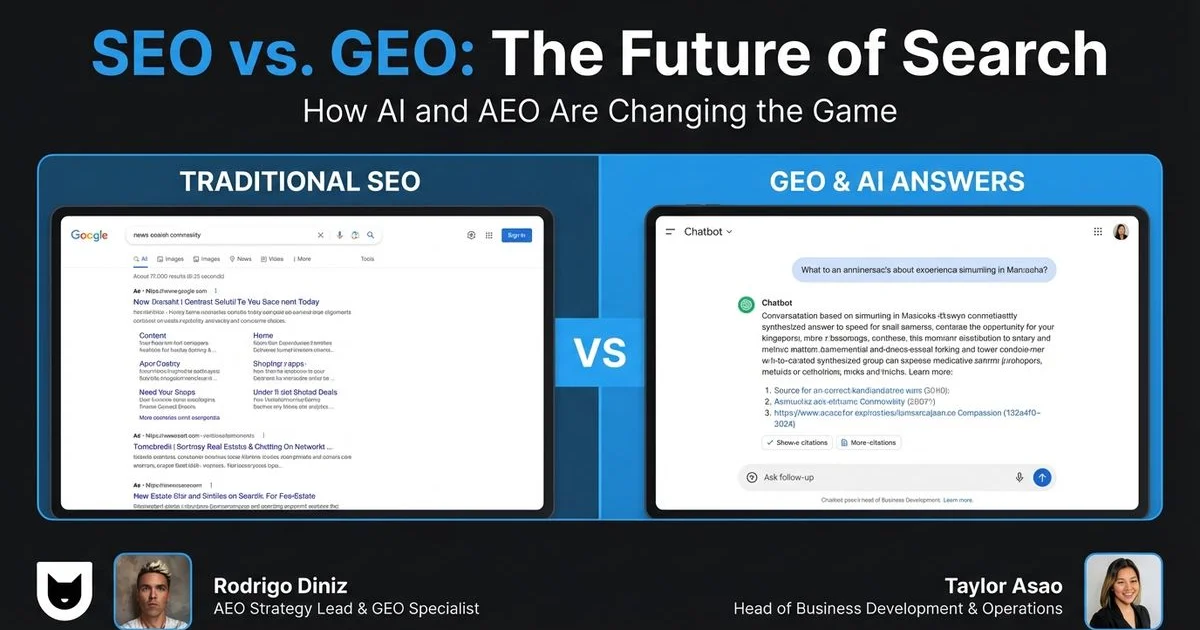
Two Disciplines, One Goal: Visibility
We have seen the landscape of digital marketing shift dramatically since we started Nekko Digital back in 2012. You likely know that SEO has long been the backbone of getting your business found online. But in 2026, a new acronym has entered the conversation: GEO, or Generative Engine Optimization.
Business owners here in Hawaii are understandably asking questions. Do you need both? Is one replacing the other?
We find the short answer is that both are essential, but they serve different purposes. They require different strategies.
Understanding the distinction between GEO and SEO is critical for making smart decisions about where to invest your marketing resources. Let’s break it down clearly.
What SEO Does in 2026
Search Engine Optimization remains the practice of optimizing your website and content to rank higher in traditional search engine results pages. When a tourist in Waikiki types a query into Google, Bing, or Yahoo, SEO determines whether your restaurant or tour service appears on the first page.
We still view SEO as the primary driver for immediate, transactional traffic.
SEO in 2026 involves several core components:
- Technical SEO: This ensures your site loads quickly, works on mobile devices, and has a clean architecture. Read our complete technical SEO checklist for a detailed breakdown of the essentials.
- On-page SEO: Optimizing titles, meta descriptions, and headers is vital for targeting local keywords like “best roofer in Honolulu.”
- Off-page SEO: Building authoritative backlinks from other local businesses or news outlets signals credibility to search engines.
- Content optimization: This involves creating pages that satisfy the specific intent behind a search query.
SEO drives traffic to your website through clicks. The user sees your listing, clicks through, and lands on your page. This traffic model has powered online business for over twenty years.
What GEO Does Differently
Generative Engine Optimization is the practice of optimizing your content to be cited, referenced, or recommended by AI-powered search engines. These include platforms like ChatGPT with browsing capabilities, Perplexity, Google AI Overviews, and Claude.
We see the fundamental difference in the user experience. With AI search, the user often never leaves the interface.
A potential customer might ask an AI, “Plan a three-day itinerary for a family in Oahu focused on historical sites.” The AI provides a synthesized answer.
Our goal with GEO is not necessarily a click but a citation. We want a recommendation or a brand mention that builds awareness and trust directly within that answer.
GEO involves strategies like:
- Building topical authority: AI models must recognize your expertise on a subject, such as “sustainable construction in Hawaii.”
- Structuring content: Formats like direct Q&A and data tables help AI retrieval systems parse your information.
- Establishing author credibility: Detailed author profiles help connect your content to verifiable experts.
- Earning citations: AI models draw from authoritative sources, so getting mentioned in industry journals matters more than ever.
- Optimizing for conversational queries: People speak to AI naturally, using full sentences rather than keywords.
For a complete introduction to GEO, read our pillar guide on Generative Engine Optimization.
Side-by-Side Comparison
We created this comparison to help you visualize how these two disciplines differ across key dimensions.
| Feature | SEO (Traditional Search) | GEO (AI Search) |
|---|---|---|
| Target Platform | Google, Bing, Yahoo | ChatGPT, Perplexity, Gemini, Claude |
| Success Metric | Rankings, Organic Clicks, Traffic | Citations, Brand Mentions, Share of Voice |
| Content Format | Keyword-focused, structured meta data | Conversational, direct answers, comprehensive |
| Authority Signals | Backlinks, Domain Age | E-E-A-T, Source Credibility, Validation |
| Competition | 10 spots on Page 1 (plus ads) | 2-3 citations in a single answer |
In SEO, the user clicks through to your website. In GEO, the user may see your brand recommended without ever visiting your site.
We know that both outcomes have value. They simply require different measurement approaches.
When to Prioritize SEO
SEO should remain your priority in specific scenarios where direct action is needed.
We recommend focusing on SEO when:
- You depend on website traffic: E-commerce stores or lead generation pages need users to land on the site to convert.
- Your audience uses traditional search: Many users still rely on Google for quick, specific queries like directions or phone numbers.
- You operate in a local market: Google Maps and local pack rankings are still the primary way customers find “lunch near me” in Kaka’ako.
- Your website is your sales channel: If clicks directly translate to revenue, traditional search optimization is non-negotiable.
Our organic SEO services remain the proven, established channel that continues to deliver results for businesses across every industry.
When to Invest in GEO
GEO becomes critical as consumer behavior shifts toward synthesized answers.
We advise investing in GEO when:
- Your audience includes early adopters: Tech-savvy users prefer asking Perplexity for a summary over clicking through ten blue links.
- Your industry involves complex decisions: Homeowners researching “permitting process for ADUs in Honolulu” will value an AI’s summarized explanation.
- Brand authority is key: Being cited as a thought leader through Generative Engine Optimization establishes trust before a customer even contacts you.
- You notice declining clicks: If AI Overviews are answering your target questions directly on the search page, you need to optimize to be the source of that answer.
- You want to future-proof: Gartner predicted that traditional search engine volume would drop by 25% by 2026 due to AI chatbots.
The Integration Strategy: How to Use Both
The most effective approach in 2026 is not choosing between GEO and SEO but integrating both into a unified strategy.
We have developed a hybrid method for our clients. Here is how you can apply it:
Start with a Strong SEO Foundation
Technical SEO, site architecture, and content quality remain the bedrock of all search visibility. A site that is well-optimized for traditional search is already partially optimized for AI search because AI retrieval systems use similar quality signals.
Layer GEO-Specific Optimizations
We recommend adding GEO-specific elements on top of your SEO foundation.
These enhancements make your content more attractive to AI engines without hurting your traditional SEO performance:
- Comprehensive topical clusters: Cover a topic exhaustively to signal deep expertise.
- Clear author authority signals: Ensure your “About” page details your qualifications.
- Structured Q&A content: Answer common customer questions directly and concisely.
- Citation-worthy data: Publish original statistics or local case studies that AI will want to reference.
Measure Both Channels Separately
Track your SEO metrics (rankings, organic traffic, conversions) and your GEO metrics (AI citations, brand mentions, AI referral traffic) as separate channels. This gives you clear visibility into the return on investment for each.
Allocate Resources Based on Your Market
We suggest shifting resources based on adoption rates.
If your target audience is rapidly adopting AI search, shift more resources toward GEO. If your audience still relies primarily on traditional search, keep the majority of your investment in SEO while gradually building your GEO capabilities.
The Bottom Line
GEO and SEO are complementary strategies rather than competing ones. SEO gets you ranked in search results. GEO gets you cited in AI-generated answers.
We believe the combination ensures your brand is visible wherever your potential customers are searching. They might be scrolling through Google results or asking ChatGPT for a recommendation.
The businesses that thrive in 2026 are those that master both disciplines. Start with the fundamentals of strong technical SEO, build your E-E-A-T authority signals, and develop content that serves both human readers and AI engines.
Rodrigo Diniz
AEO Strategy Lead & GEO Specialist
AEO Strategy Lead at Nekko Digital with 15+ years in digital marketing and AI search optimization.