Keyword Research for Small Business: A Practical Guide
Learn how to find the right keywords for your small business without expensive tools. A practical, no-fluff guide to keyword research that drives real traffic.

AEO Strategy Lead & Co-Founder
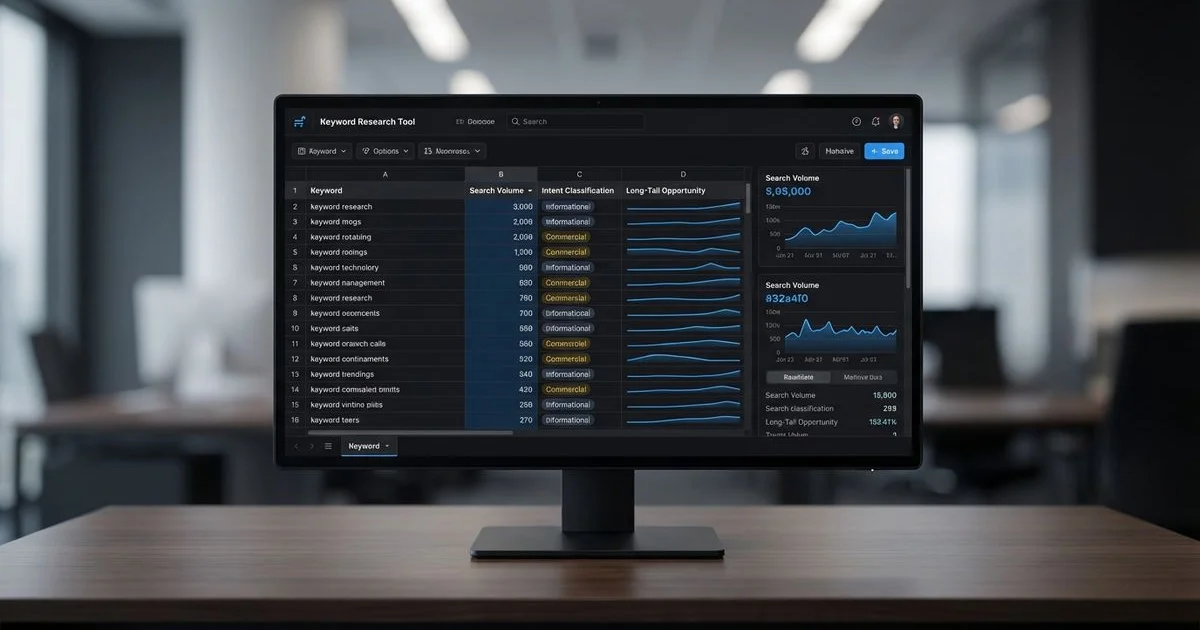
Keywords Are the Bridge Between Your Business and Your Customers
We often tell our clients in Honolulu that being online isn’t enough if your neighbors can’t find you.
Recent data shows that 73% of online activity in Hawaii now happens on smartphones. That means your potential customer isn’t sitting at a desk researching; they are likely walking down Kalakaua Avenue or sitting in traffic on the H-1, looking for an immediate solution. Keyword research is simply the method we use to ensure your business appears in that exact moment of need.
For local businesses here in the islands, you don’t need a massive budget or an army of analysts. You just need to understand how locals and tourists actually speak when they type into that search bar.
This guide breaks down our exact process for finding the terms that drive revenue, not just traffic. It is a core component of any successful organic SEO campaign.
Understanding Search Intent: The “Why” Behind the Search
We prioritize intent over search volume every single time.
Search intent tells us why someone is looking for a phrase. Google’s algorithms have evolved to prioritize this heavily, meaning a blog post will almost never rank for a keyword where the user clearly wants to buy a product. If you misjudge this, you will waste hours creating content that has zero chance of ranking.
Here is how we categorize intent for Hawaii-based businesses:
Informational Intent
The user wants to learn or solve a problem. In our experience, these searchers are rarely ready to pull out their credit card immediately. They are looking for trusted advice.
Examples:
- “How to fix a leaking roof in Manoa” (Construction)
- “Best time of year to sell a house in Oahu” (Real Estate)
- “Parking rules in Waikiki” (General)
For small businesses, targeting these keywords builds the authority that leads to sales later. It is the foundation of your content strategy.
Navigational Intent
The user already knows your name and is just trying to find your specific site or physical location.
Examples:
- “Nekko Digital Honolulu”
- “Zippy’s menu pdf”
- “Login to Hawaii State FCU”
Your goal here is simple: make sure your Google Business Profile and homepage are technically sound so you don’t lose these easy wins.
Commercial Investigation Intent
The user is narrowing down their choices. We see this heavily in the tourism and dining sectors, where people compare options before committing.
Examples:
- “Best poke near Kaka’ako” (Restaurant)
- “Top rated general contractors Kailua” (Construction)
- “Kakaako condos vs. Ward Village” (Real Estate)
This traffic is incredibly valuable because the user is educated and close to a decision.
Transactional Intent
The user is ready to buy or hire right now. These are your “money keywords.”
Examples:
- “Order lunch delivery Honolulu”
- “Hire emergency plumber Ewa Beach”
- “Schedule open house viewing 96813”
Your service pages must aggressively target these terms.
| Intent Type | What They Want | Hawaii Example | Best Page Type |
|---|---|---|---|
| Informational | Answers | ”Is solar worth it in Hawaii?” | Blog Post |
| Navigational | A Specific Brand | ”Nekko Digital phone number” | Homepage / Contact |
| Commercial | Comparison | ”Best luau for toddlers Oahu" | "Best of” List / Landing Page |
| Transactional | To Buy/Hire | ”Book plumbing repair near me” | Service Page |
Free Tools for Keyword Research
We run expensive agency software like Ahrefs, but you can get 90% of the way there with free tools if you know how to use them.
Here are the specific tools we recommend to our local clients:
Google Search Console
This is the only tool that gives you 100% accurate data on how people already find you. Navigate to the “Performance” tab to see the exact queries driving clicks. We often find that a business is ranking on page 2 for a valuable term like “condo renovation” without even trying, which is a perfect opportunity to optimize.
Google Autocomplete & “Incognito” Mode
Start typing a query into Google, but do it in an “Incognito” or “Private” window. This prevents your personal search history from biasing the results. The suggestions that drop down are not random; they are predictions based on millions of real searches. If you type “Honolulu realtor,” and Google suggests “for military relocation,” you have just found a powerful niche keyword.
Google’s People Also Ask
Look at the “People Also Ask” box in the search results. These questions are gold mines for blog topics. If you answer these specific questions clearly on your site, you increase your chances of appearing in the “featured snippet” slot, which is key for answer engine optimization.
Google Keyword Planner
This tool is built for advertisers, but it is excellent for SEO too.
The “Insider” Warning: If you don’t have an active ad campaign running, Google will only show you vague ranges (like “1k-10k searches”) instead of exact numbers. Don’t worry about this. For a small business, knowing that a term has “1k-10k” searches is enough to know it’s popular. You don’t need the exact digit to make a smart decision.
Google Trends
We use this to track island-specific seasonality. You might see that searches for “air conditioning repair” in Kapolei spike in May, giving you a clear deadline for when your content needs to be published.
The Power of Long-Tail Keywords
Long-tail keywords are specific phrases (usually 3+ words) that have lower search volume but much higher intent.
Data suggests that long-tail keywords convert at approximately 36%, compared to just 11% for top-level landing pages. For a local business, this is the difference between a visitor and a customer.
Consider this real estate example:
-
Head Keyword: “Hawaii Real Estate”
- Volume: High
- Competition: Impossible (Zillow, Redfin, Realtor.com)
- Intent: Vague
-
Long-Tail Keyword: “2 bedroom condo for sale Kakaako pet friendly”
- Volume: Low
- Competition: Low
- Intent: Very High (Ready to buy)
We advise our clients to focus almost exclusively on long-tail phrases. You will rank faster, and the people who find you will actually want what you sell.
Mapping Keywords to Pages
Ranking for a keyword doesn’t help if the user lands on the wrong page.
Keyword mapping is the strategic process of assigning specific keywords to specific URLs. This prevents “keyword cannibalization,” where two of your own pages fight for the same spot in Google.
Service Pages
Map your transactional keywords here. If you are a contractor, you should have a dedicated page for “Kitchen Remodeling” targeting exactly that phrase. Do not dilute this page with general tips; keep it focused on your offer and portfolio.
Blog Posts
Map informational queries here. A post titled “5 Things to Know Before Renovating a Condo in Honolulu” captures the research crowd. You can then link from this blog post to your “Kitchen Remodeling” service page to guide them down the funnel.
Location Pages
Hawaii businesses often serve multiple distinct areas. A dedicated local SEO strategy ensures you rank where your customers are searching. We recommend creating specific pages for major hubs if you want to rank there. A restaurant might have a “Catering in Kailua” page and a separate “Catering in Kaneohe” page. For more on this structure, check our local SEO tips for Hawaii businesses.
Homepage
Your homepage should target your broadest brand and category terms. Think “Construction Company Oahu” or “Italian Restaurant Waikiki.” Let your sub-pages handle the specific services.
Prioritizing by Business Impact
You cannot target every keyword at once.
We use a simple “Scorecard” method to help clients decide what to tackle first. Rate each keyword on a scale of 1-3 for these three factors:
- Relevance: How closely does this match what you actually sell? (3 = Perfect match).
- Competition: Can you beat the current top results? (3 = Weak competition).
- Value: If they click, is the deal worth a lot of money? (3 = High ticket).
The Calculation: Multiply the scores together. A keyword with a perfect score (27) should be your top priority. A keyword with a score of 1 or 2 is likely a waste of time.
- Example: “Cheap handyman” might have high volume, but if you are a premium builder, the Relevance is 1.
- Result: 1 x 3 x 3 = 9. This is a low priority.
Focus on the terms that score 18 or higher. These are your quick wins that will generate cash flow to fund further marketing.
From Research to Results
Keyword research is only the first step in a long game.
We have seen too many businesses do the research and then fail to execute. You must create high-quality content for each keyword, ensure your site has solid technical SEO, and be patient.
Start with a small list of 10 high-value keywords. Build a dedicated page or post for each one. Watch your rankings in Google Search Console over 3-6 months, and then expand.
Consistently answering your customers’ questions better than anyone else is the only “secret” that matters. That is how you win in the islands.
Rodrigo Diniz
AEO Strategy Lead & GEO Specialist
AEO Strategy Lead at Nekko Digital with 15+ years in digital marketing and AI search optimization.