Measuring Social Media Advertising ROI: A No-Nonsense Guide
Stop guessing if your social media ads work. This guide shows you exactly how to measure and improve ROI from Facebook, Instagram, and LinkedIn campaigns.

AEO Strategy Lead & Co-Founder
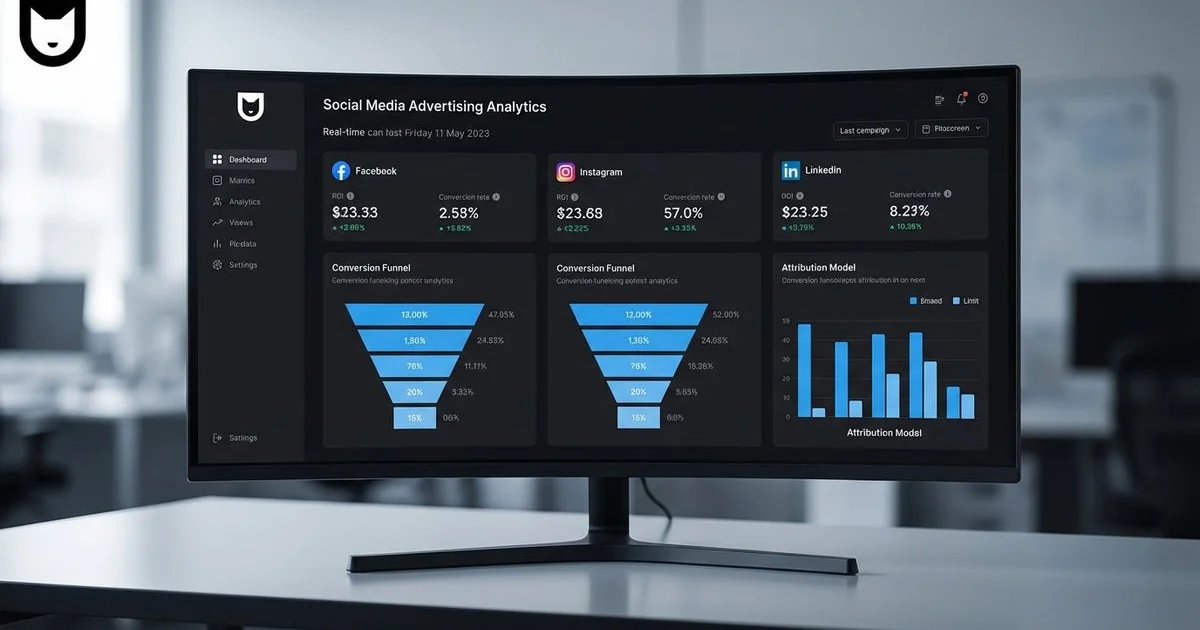
Based on your instructions, here is the enriched and rewritten article.
The ROI Measurement Gap in Social Media Advertising
We know how expensive it is to run a business here in Honolulu, where overhead costs are already among the highest in the nation. Spending money on ads without knowing the exact return is a luxury most local companies simply cannot afford. Yet, a 2025 Gartner survey suggests that nearly 30% of digital ad budgets are wasted on inefficient channels or poor tracking.
The problem isn’t a lack of data; it’s usually an overflow of the wrong kind. Platforms like Meta and LinkedIn provide thousands of rows of analytics, but for a busy general contractor or restaurant owner, deciphering which numbers actually pay the rent is overwhelming.
Our team has spent over a decade refining digital products, and we have found that bridging this gap requires ignoring 90% of the metrics you see to focus entirely on the few that drive profit. This guide outlines the exact framework we use to measure social media ROI, ensuring every dollar spent contributes to your bottom line. It is the same methodology behind our social media advertising service.
Meaningful KPIs vs. Vanity Metrics
Not all metrics deserve your attention, especially when you are trying to calculate genuine business value. The first step in measuring ROI is distinguishing between numbers that look impressive on a report and numbers that indicate money in the bank.
Vanity Metrics to Deprioritize
- Impressions: This number tells you how many times an ad was displayed on a screen. A million impressions that generate zero leads have zero business value.
- Likes and Reactions: Social engagement rarely correlates with purchasing behavior. A post with a thousand likes and no conversions is a failed ad.
- Follower Count: Growing a following without a strategy to monetize it creates an audience, not a customer base.
Business-Impact Metrics to Focus On
We prioritize these five metrics because they tell the true story of your campaign’s financial health.
- Cost Per Lead (CPL): This is your price tag for a potential customer. For example, in 2025, we see local real estate CPLs ranging from $100 to $350 in competitive markets like Oahu, while local restaurants might see CPLs (like a reservation booking) as low as $3.50.
- Cost Per Acquisition (CPA): This measures the cost to acquire a paying customer, not just a lead.
- Return on Ad Spend (ROAS): Revenue generated divided by ad spend. A ROAS of 4.0 means you make $4 for every $1 you spend.
- Conversion Rate: The percentage of clicks that turn into action.
- Customer Lifetime Value (CLV): The total revenue a customer generates over their entire relationship with you.
The Metrics Comparison Table
| Metric | Type | Why It Matters (The “So What?”) |
|---|---|---|
| Impressions | Vanity | Good for ego, bad for paying bills. It only proves your ad was loaded, not seen or read. |
| CPA (Cost Per Acquisition) | Actionable | The ultimate truth. If your CPA is lower than your profit margin, you can scale indefinitely. |
| CTR (Click-Through Rate) | Diagnostic | A low CTR (below 1%) usually means your creative or headline isn’t resonating with the local audience. |
| ROAS | Actionable | The efficiency score. We recommend aiming for a minimum 3:1 ratio for service businesses to cover overhead. |
Attribution Models: Understanding the Customer Journey
Attribution is simply deciding which marketing touchpoint gets the credit for a sale. Most customers interact with your brand multiple times—seeing an Instagram Story, Googling your reviews, and finally clicking a retargeting ad—before they buy.
Last-Click Attribution
The simplest model gives 100% of the credit to the very last interaction before conversion. If a customer clicks a Google ad right before buying, Google gets all the credit, even if a Facebook video introduced them to your brand three weeks ago.
This model is easy to setup but dangerous for social media strategy because it systematically undervalues the “awareness” work done by platforms like Instagram.
Data-Driven Attribution (The New Standard)
We strongly recommend moving away from rule-based models like “First-Click” or “Last-Click” entirely. Google Analytics 4 (GA4) now defaults to Data-Driven Attribution.
This model uses machine learning to analyze every touchpoint in a user’s journey and assigns fractional credit to each one based on its actual influence. For a home builder in Kaka’ako, this might reveal that while Google Ads closes the deal, it was actually the LinkedIn project showcase that started the conversation 90 days earlier.
The iOS Privacy Factor
You must also account for Apple’s Link Tracking Protection, introduced in iOS 17 and refined through 2025. This feature strips tracking parameters (like fbclid) from links in Mail, Messages, and Private Browsing.
Insider Tip: Because of these privacy blocks, your ad platforms will likely under-report conversions by 15-20%. We always cross-reference platform data with your actual backend sales data to find the “truth” somewhere in the middle.
Calculating CPA Across Platforms
Cost Per Acquisition (CPA) is the single most important metric for determining if your ads are profitable. It tells you exactly how much you spent to get a paying customer.
The Basic Formula
CPA = Total Ad Spend / Number of Acquisitions
If you spent $2,000 on Facebook ads last month and those ads resulted in 20 new customers, your CPA is $100.
The “Island Math” Example
Context is everything when looking at these numbers. Let’s look at a theoretical high-end renovation firm in Honolulu.
- Ad Spend: $5,000
- Leads Generated: 50
- Cost Per Lead: $100
- Closing Rate: 10% (5 Clients)
- CPA: $1,000
A $1,000 CPA sounds expensive until you consider the project value. If each renovation brings in $50,000 in revenue, spending $1,000 to acquire the customer is a phenomenal investment (50x ROAS). However, for a plate lunch spot, a $1,000 CPA would be disastrous. You must define your own “profitability line” before you launch.
Platform-Specific Tracking
Facebook and Instagram (Meta)
The Meta Pixel is no longer enough on its own. To get accurate data in 2026, you must implement the Conversions API (CAPI).
This tool sends data directly from your website’s server to Meta, bypassing browser restrictions like ad blockers and iOS privacy settings. Using CAPI typically recovers 10-20% of the conversion data that the Pixel misses.
- Action Step: If you use Shopify or WordPress, you can enable CAPI integration in your settings with just a few clicks—no coding required.
- Meta Gateway: For custom sites, use the Meta Gateway to set up a cloud-based connection without heavy engineering work.
LinkedIn is the powerhouse for B2B industries like construction, architecture, and commercial real estate. The LinkedIn Insight Tag functions similarly to the Meta Pixel but offers unique demographic data.
We find the real value here is the “Matched Audiences” feature. You can upload a list of target companies (e.g., specific hotels or developers in Hawaii), and LinkedIn will report back exactly how many decision-makers at those companies saw your ads, even if they didn’t click. This “account-level” visibility is worth the higher average Cost Per Click (often $8-$12+).
Google Ads (for Comparison)
While not a social platform, comparing your social media CPA against your Google Ads CPA provides a necessary benchmark. Google Search captures “high intent” traffic (people searching for a solution right now), so it usually has a higher conversion rate but a higher cost.
If Google Ads delivers leads at $80 CPA and Facebook delivers them at $120 CPA, do not immediately cut Facebook. Check the lead quality. We often find that while social leads cost more to acquire, they may have a higher lifetime value or brand loyalty because they engaged with your content first.
Optimization Strategies for Improving ROI
Audience Refinement
The days of manually selecting “males aged 25-40 who like sports” are fading. Modern algorithms perform better with broad targeting combined with high-quality creative.
We recommend providing the platform with a “seed audience”—such as a customer list of your top 100 clients—and letting the AI find people who “look” like them. This “Lookalike” or “Advantage+ Audience” approach frequently lowers CPA by 20-30% compared to manual guessing.
Creative Testing (The New Targeting)
In 2026, your ad creative is your targeting. If you create a video about “luxury kitchen renovations in Kahala,” the algorithm will naturally show it to people interested in luxury renovations.
- The 3-Element Test: Systematically test one variable at a time:
- The Hook: The first 3 seconds of the video.
- The Headline: The bold text under the image.
- The Offer: What they get for clicking (e.g., “Free Consultation” vs. “Instant Quote”).
- Pro Tip: Use Meta’s “Dynamic Creative” feature. Upload 3 images and 3 headlines, and let the system automatically mix and match them to find the winning combination for each user.
Landing Page Optimization
Your ads are only as effective as the destination they lead to. If you are paying $5 per click to send traffic to a slow, confusing homepage, you are burning cash. Ensure your landing pages follow conversion rate optimization best practices by removing navigation menus, keeping the form above the fold, and matching the headline of the page exactly to the headline of the ad.
Budget Allocation
Review your performance weekly, but do not react daily. Algorithms need 5-7 days to “learn” and optimize.
We see many business owners panic and turn off an ad after 24 hours of poor performance. This kills the “learning phase” and resets the algorithm. Instead, shift budget monthly based on the ROAS trend, moving funds from low-performing campaigns to the ones driving the most revenue.
Retargeting
Retargeting remains the highest ROI activity for most businesses. These campaigns target users who visited your site but didn’t buy. Since these users already know who you are, the cost to convert them is significantly lower.
The “Offer Ladder” Strategy:
- Visit 1 (Cold): Show educational video.
- Retargeting Level 1 (Warm): Show client testimonials or case studies.
- Retargeting Level 2 (Hot): Show a direct offer or discount to close the deal.
Building a Reporting Framework
You need a single source of truth to avoid drowning in spreadsheets. We suggest automating your reporting using tools like Looker Studio (formerly Google Data Studio).
You can connect Facebook, Google, and LinkedIn data into one dashboard using a connector like Porter Metrics or Supermetrics. Your monthly report should track:
- Total ad spend by platform.
- Blended CPA (Total Spend / Total Customers across all channels).
- ROAS for revenue-generating campaigns.
- Trend lines showing month-over-month performance.
Review this report monthly to make unemotional, data-backed decisions. Identify what is working, cut what is not, and reinvest the savings into your winners.
This systematic approach turns social media from a slot machine into a predictable asset. Pair your paid strategy with strong organic foundations like SEO and forward-looking AI search optimization to dominate your market from every angle.
Rodrigo Diniz
AEO Strategy Lead & GEO Specialist
AEO Strategy Lead at Nekko Digital with 15+ years in digital marketing and AI search optimization.